
Wellbeing- A Physics Paradox
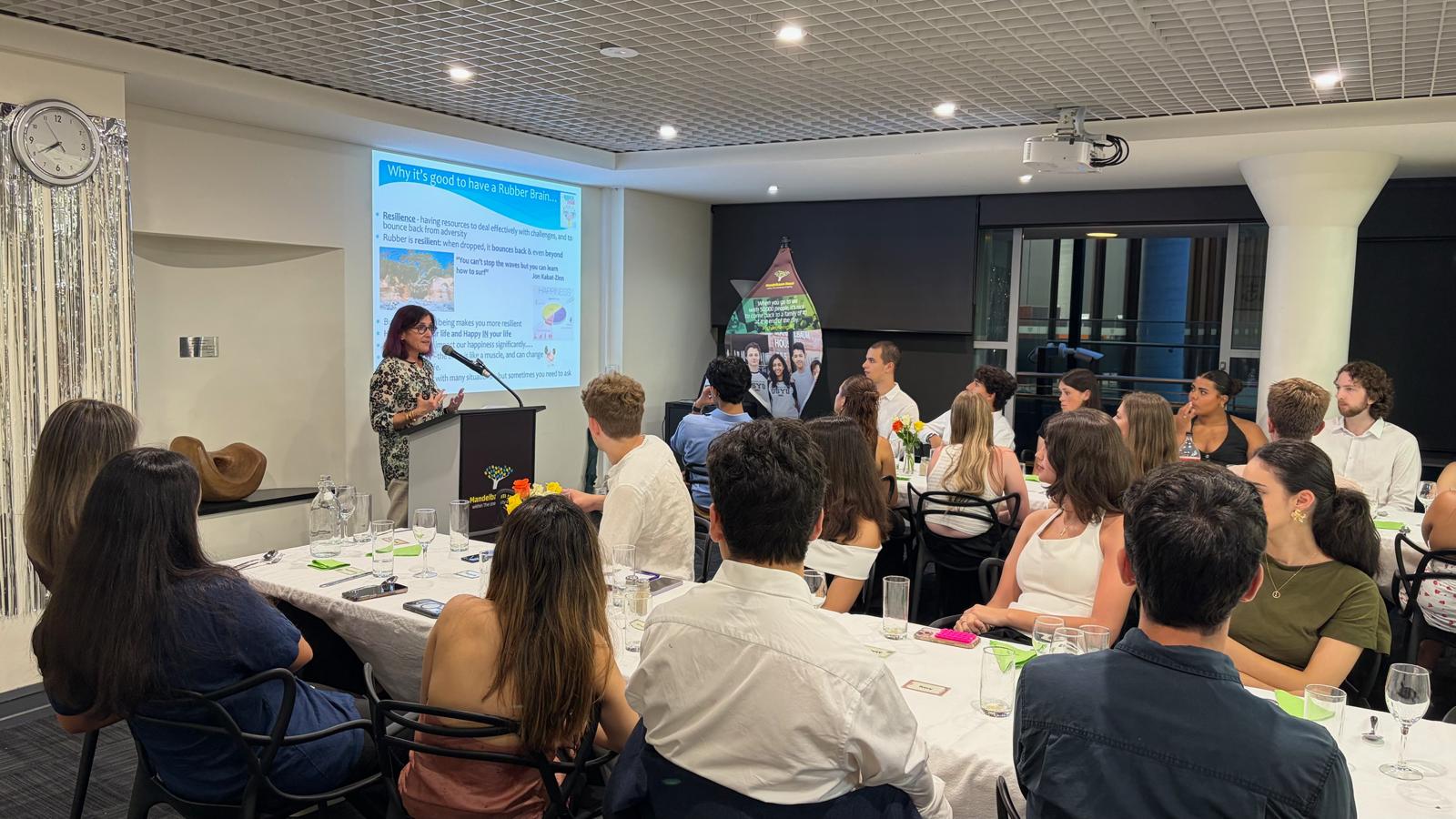
Newton’s third Law states that every action generates an opposite reaction. That every time my hand pushes against the wall, the wall pushes back with equal and opposite force. This concept is valid in Physics, but we seem to have generalised it to every aspect of our lives- whenever we are pushed out of our comfort zones, we push back. But wouldn’t it be healthier- easier, even- to accept and adapt to these situations than to fight them? This is Dr. Sue Morris’ philosophy, which she masterfully shared at Mandelbaum House.
“The Rubber Brain”, she called it, the Psychology-approved method to wellbeing. Thinking flexibly, positively, to bounce back from hardship like a rubber ball. In this framework, our attitude towards problems is what determines our response, not the problem itself. For example, we may feel impatient and stressed when we are late to an event. Once we become aware of our thinking, we can choose to shift it.
Dr. Morris said it helps to think of the worst-case scenario when stressed, so let us try it out with this situation. The worst thing that can happen if we were late, is to wait in traffic for 6 consecutive hours, without access to a bathroom. Then, as we finally arrive at the event, it is over, and everybody is mad at us for not being on time. But that is extremely improbable.
So, what is so bad about being late that it involves our feeling terrible, running, sweating and dropping the water bottle on the way? I would much rather accept my tardiness, be flexible (rubber), and get there safe and sound. Calm.
The thing is- our brains are fallible. They evolved solely for survival, not for our comfortable lifestyles without having to run from tigers every day. We have in-built biases that prevented us from dying back then and prevent us from adapting to challenges now. For example, when I enter a room, greeted by a thousand smiles, I notice the one girl rolling her eyes at me. This is called the negativity bias.





Stereotypes and black-and-white thinking also cling to our thinking like leeches. Not to mention mind-reading- we believe we know what everyone else thinks of us, without any proof. We are not Jedi, that is impossible! Despite that, these are the tenets that dictate our lives.
But, good news, we can change this way of thinking, and the first step is to recognise negative habits. The second step is to implement strategies that help us think more positively and enjoy life without stressing too much.
For one, try thinking of three good things that happened today. Yes, do it right now. When Dr. Morris suggested this strategy at the conference, I turned to my friend Cara, who was sitting next to me, and we simultaneously said “you”. Safe to say, this talk has already impacted my life in the most beautiful way.
Other strategies include box breathing, listening to music, exercising and connecting with others. Because, when we are stressed, our brains release cortisol, adrenaline and oxytocin. The hugging hormone. Talking to a friend is always a good idea, scientifically proven!
At the end of the conference, we sang Happy Birthday to Aakash, Izzy, Maher and Catherine, and shared a delicious meal together.
Newton stated that every action generates an opposite reaction. And I think, in this case, we should completely ignore him.
Article: Paula Celada Zimeri (resident)
Photos: Sage Buys and Sophia Walker (residents)